 Sign In
A Simple Guide to APA Style Title Pages
The title page is the first thing a reader, instructor, or journal reviewer sees when they open your paper. A correctly formatted APA style title page signals that you understand academic writing conventions and sets a professional tone before your argument even begins. The American Psychological Association (APA) has specific formatting requirements for title pages, and those requirements differ depending on whether you are submitting a student paper or a professional paper for journal publication. This guide covers everything you need to know about formatting an APA style title page according to the 7th edition.
APA Style Title Page Requirements: 7th Edition
General Requirements for All APA Title Pages
Several formatting rules apply to both student and professional APA title pages. Understanding these general requirements is the starting point for formatting any APA cover page correctly.
Page number. The page number 1 should appear in the upper-right corner of the title page. All subsequent pages of the document should also be numbered consecutively.
Title. The title should be centered horizontally and positioned in the upper half of the page. It must be formatted in boldface, and all text on the title page should be double-spaced. The APA recommends a title that is focused and concise. It's free of abbreviations and unnecessary filler words. APA style titles typically run one to two lines and should not exceed two lines.
Author name(s). Place the author's full name directly below the title, including first name, middle initial(s), and last name. Do not include titles or degrees such as PhD, MD, or MS on the APA title page. If a paper has multiple authors, list them in order of contribution: the first author contributed the most, with subsequent authors contributing less. In some disciplines, the last author is considered a senior author who guided the project.
When all authors contributed equally, list them alphabetically by last name. When only some authors contributed equally, designate those authors with a symbol such as an asterisk, and include a note beneath the author list explaining the shared contribution.
Institutional affiliation. Below the author names, list the institutional affiliation, or the department and institution where the research was conducted (e.g., Department of Medicine, Bright Future University). Some cover pages also request the city and state of the institution. When authors are affiliated with different institutions, use superscripts to indicate each author's affiliation clearly.
APA Style Title Page for Student Papers
Student papers written in APA format require all of the general components described above, plus several additional elements specific to academic assignments. These elements provide context about the course and assignment for which the paper was written.
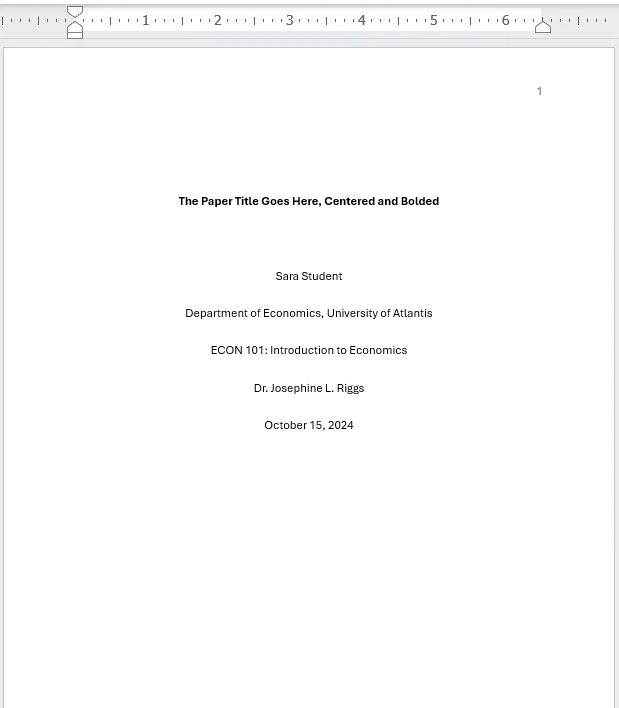
Below the author name and institutional affiliation, student APA title pages must also include the name of the course for which the paper was written, the name of the course instructor, and the due date of the assignment. All of this information should be centered on the page and double-spaced, consistent with the rest of the title page.
To recap, a student APA style title page requires: a page number, the paper title in bold, the full name(s) of the author(s), the institutional affiliation, the course name, the instructor's name, and the assignment due date.
APA Style Title Page for Professional Papers
Professional papers submitted for publication in academic journals follow a different APA title page format than student papers. In addition to the general requirements, professional APA title pages include two additional components: a running head and an author note.
Running head. The running head is a shortened version of the paper's full title, placed flush left in the header of the title page. It captures the essence of the title in just a few words and functions as a brief subtitle for the document. The running head cannot exceed 50 characters, including spaces and punctuation. While the running head appears on the left side of the header, the page number remains in the upper-right corner of the same line.
Author note. The author note appears below the institutional affiliations and contains several important pieces of information. It typically includes the authors' ORCID iDs with corresponding URLs, current institutional affiliations, and a note if any author died during the writing or publication process. The author note also includes disclosures such as conflicts of interest, acknowledgements of grant funding or other financial support, study registrations, data sharing practices, and open science declarations. Finally, the author note provides contact information for the corresponding author, which is typically an email address for readers who have questions about the paper.
To recap, a professional APA style title page requires: a running head in the upper-left header, a page number in the upper-right header, the paper title in bold, the full name(s) of the author(s), the institutional affiliation(s), and a complete author note. The APA's author note guidelines provide detailed guidance on what to include.

APA Title Page: Student vs. Professional (Key Differences)
The table below summarizes the key differences between student and professional APA style title pages in the 7th edition:
Student papers include: page number, bold title, author name(s), institutional affiliation, course name, instructor name, and assignment due date.
Professional papers include: running head (upper left), page number (upper right), bold title, author name(s), institutional affiliation(s), and a full author note with ORCID iDs, disclosures, acknowledgements, and corresponding author contact information.
Both require: page number, bold centered title, author name(s) without titles or degrees, and institutional affiliation.
Resources for Formatting APA Style Title Pages
Several reliable resources are available to help with APA title page formatting. For student papers, Purdue OWL, the Purdue Online Writing Lab maintained by Purdue University, is one of the most comprehensive free references for APA style. It covers title page formatting, in-text citations, reference lists, and more.
For professional papers, the best source is the specific academic journal to which you are submitting. Many journals have their own formatting requirements that may differ slightly from standard APA guidelines. The APA also provides official annotated examples of professional papers in APA format, which are particularly useful when preparing a manuscript for submission.
How Editor World Can Help
Formatting your APA title page correctly is an important first step, but it's just one part of producing a strong academic paper. Once your structure is in place, the quality of your writing becomes the priority. A professional editing service ensures your paper is not only formatted correctly, but that every section is clear, well-argued, and free of errors before it reaches an instructor or journal reviewer. Editor World offers professional editing and proofreading services specifically tailored to academic and professional writers working in APA style and other major style guides.
Editor World connects you with experienced academic editors who can review your paper for grammar, clarity, consistency, and APA style compliance — helping you submit your best work with confidence.